By Jesse Noble, Teledyne Marine
CSIRO‑deployed APEX float survives eight months beneath the Denman and Shackleton Ice Shelves, returning unprecedented observations that sharpen understanding of ice melt processes.
A
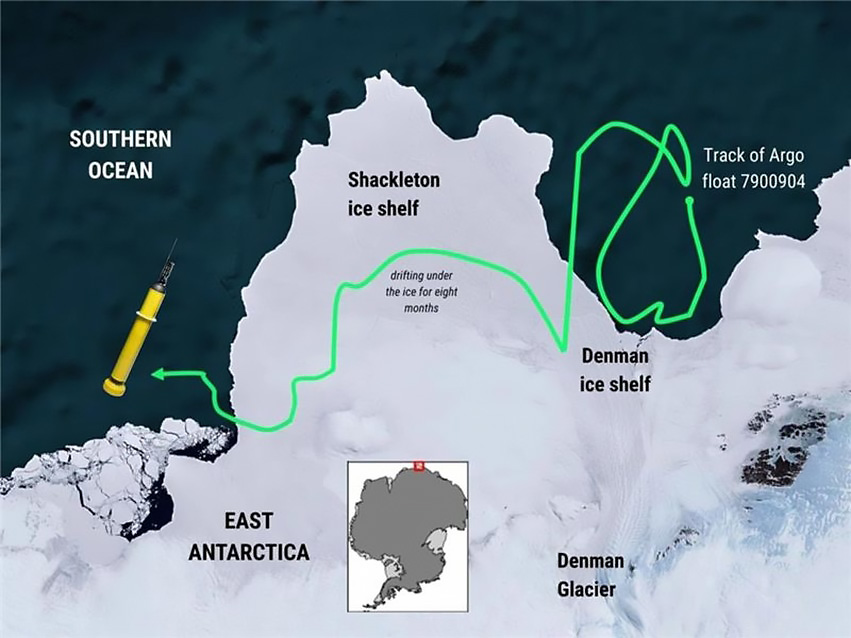
Teledyne Webb Research APEX autonomous profiling float (SN 8851, WMO 7900904) deployed by CSIRO, Australia's national science agency, has achieved a world‑first under‑ice ocean transect in East Antarctica after vanishing beneath the Denman and Shackleton Ice Shelves and reappearing eight months later. The mission produced around 200 ocean profiles over 2.5 years on a ~300 km long transect, opening a new window into how ocean conditions drive basal melting and ice‑shelf stability.
Scientific Significance
The paper, “Circulation and ocean–ice shelf interaction beneath the Denman and Shackleton Ice Shelves," published in Science Advances, reports that warm water at depth reaches the cavity beneath Denman Glacier, driving strong basal melt and placing the glacier on a delicate threshold where small increases in the thickness of the warm layer could trigger unstable retreat. By contrast, the Shackleton Ice Shelf is currently not exposed to sufficiently warm water capable of rapid basal melt. Crucially, the float captured conditions within the ~10‑meter boundary layer immediately beneath the ice—where ocean‑ice heat exchange largely controls the melt rate—providing data that can be directly assimilated into models to reduce uncertainty in future sea‑level projections.
Technology Behind the Breakthrough
TWR's APEX floats are cost‑effective, long‑endurance oceanographic instruments that vertically profile by changing buoyancy—typically cycling to depths of up to 2,000 meters while measuring temperature, salinity, and pressure, and transmitting data via satellite when surfacing. These capabilities, pioneered for the global Argo array, enable persistent, wide‑area coverage without a ship or propeller. While profiling floats cannot steer laterally, their autonomous vertical sampling and resilience make them uniquely suited to extreme environments. In this mission, the APEX float recorded the depth of the ice base whenever it contacted the underside of the shelf, allowing scientists to reconstruct the float's under‑ice pathway by matching “ice‑draft" measurements with satellite data—a creative approach that made the under‑ice transect possible. The APEX floats have an 'ice avoidance' feature which can be adjusted to keep the floats safe while traveling under ice for up to months at a time.
Partner Perspectives
CSIRO scientists note that boundary‑layer observations from floats can improve how ocean‑ice interactions are represented in computer models, helping reduce the largest uncertainty in sea‑level projections: the Antarctic contribution. They also emphasize that deploying more floats along the Antarctic continental shelf would transform our understanding of ice‑shelf vulnerability to changing ocean conditions.
About Teledyne Webb Research
Teledyne Webb Research designs and manufactures APEX autonomous profiling floats used throughout the Argo program, delivering reliable, cost‑effective platforms for global ocean observation and climate research. With more than 10,000 APEX floats supplied to Argo, TWR continues to advance ocean sensing technologies for hard‑to‑sample regions, including polar ice‑shelf cavities.
Further Reading

