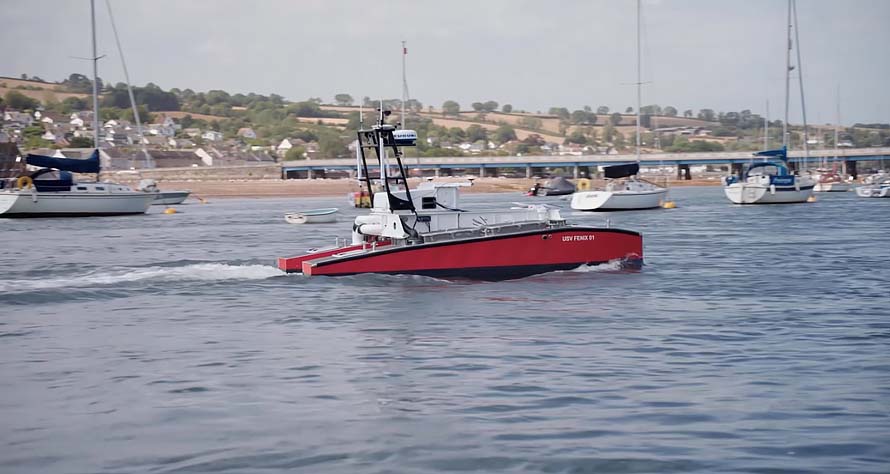
How HydroSurv, Subsea Fenix and Teledyne Marine brought together vessel design, operational expertise and multibeam technology on USV Fenix 01.
A survey vessel is only as capable as the work it can perform.
For Subsea Fenix, years of operating small uncrewed surface vessels have provided plenty of evidence of what remote surveying could offer. But as the company took on increasingly varied work, the need for a platform with greater range, flexibility and payload capability became clear.
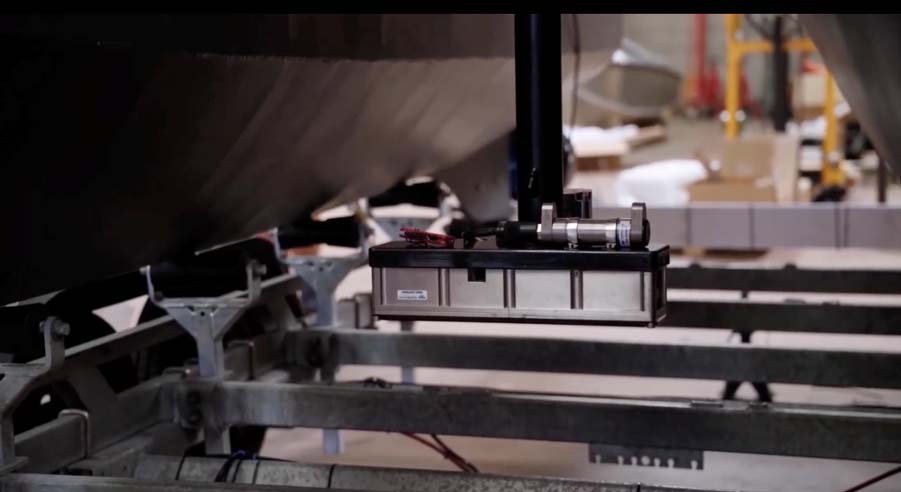
That led to a new project with UK-based USV manufacturer, HydroSurv to develop the USV FENIX 01, a platform designed around Subsea Fenix’s operational requirements. Teledyne RESON’s SeaBat T51-ASV multibeam echosounder was selected as a key part of its hydrographic survey capability, bringing proven high resolution sonar technology to the new vessel.
The
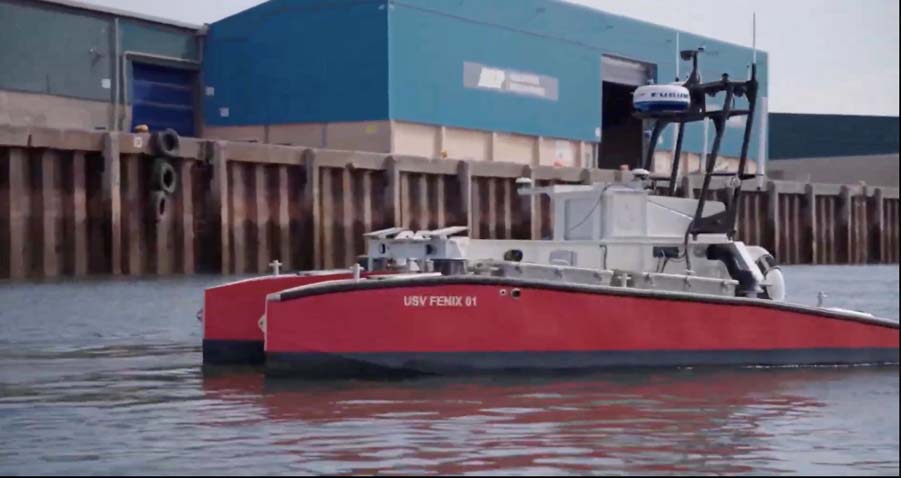
USV FENIX 01 is a 5.7m battery-hybrid vessel which combines HydroSurv’s REAV-60 platform with a modular payload architecture that allows it to be configured for different types of survey and subsea operations.
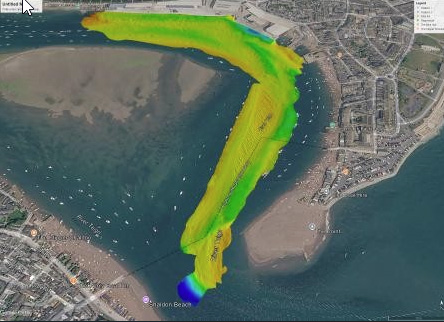
Now undergoing its first operational phase in Italy, the first bathymetric data recently collected from the vessel offers an early look at what this combination can deliver.
A familiar piece of the puzzle
While the HydroSurv vessel itself represented a new step for Subsea Fenix, the technology at the heart of its hydrographic survey capability was already familiar.
Subsea Fenix has worked with Teledyne BlueView sonars since 2013 and in 2018 it was Codevintec Italiana Srl , that introduced Subsea Fenix to the SeaBat range by Teledyne RESON. That established relationship meant the team already understood the equipment, the acquisition and processing workflow, and the calibration and patch-test procedures.
For Subsea Fenix, that familiarity was valuable when moving to a new vessel platform. HydroSurv could develop the USV around the company's operational requirements, while Teledyne worked with HydroSurv to integrate a SeaBat T51-ASV into the vessel’s survey configuration.
“There was no hesitation over the multibeam” says Stefano Mancini, CEO of Subsea Fenix.
The SeaBat T51-ASV was selected for its ability to deliver the resolution required for detailed bathymetric surveying while maintaining the coverage needed to keep missions efficient.
Operating in the 700–800 kHz range, the system provides high-resolution data while maintaining coverage of up to seven times the water depth.
Its autonomous sonar controls are also suited to the way USV FENIX 01 will operate, reducing the number of interventions needed at the sensor when the vessel is being controlled from shore.
“The SeaBat T51 delivers the resolution we were after while maintaining coverage of up to seven times water depth, so the detail does not cost you mission hours,” says Stefano.
“On top of that, the T51-ASV's autonomous sonar controls reduce the number of interventions required on the sensor – a real advantage when you are operating from shore.”
The first look beneath the surface
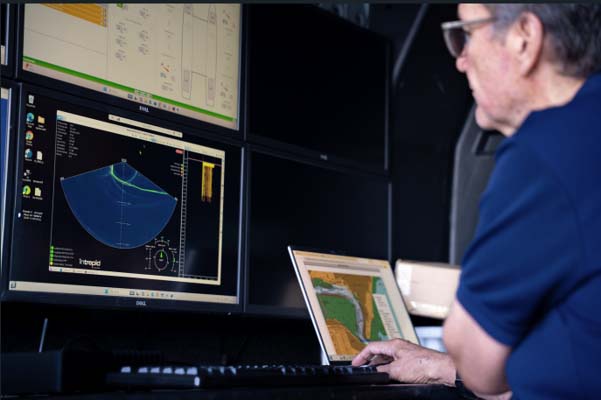
USV FENIX 01 completed its initial commissioning phase in August 2026, reaching Category A under the IMCA M257 framework. During this phase, the vessel collected its first bathymetric data using the Teledyne SeaBat T51-ASV.
The first results provide an early indication of how the new platform performs in operation, building on Subsea Fenix’s years of experience with smaller USVs and more than 400 survey projects.
Mancini said:
“USV Fenix 01 is designed to provide high-efficiency solutions across diverse maritime sectors, starting with environmental monitoring to demonstrate its operational reliability. The broader market strategy focuses on expanding into pipeline integrity and pre-survey applications for various offshore energy and infrastructure projects."
“By utilising uncrewed technology, the platform offers a flexible and scalable approach to data collection that meets the rigorous demands of global subsea industries.”
The next stages of USV FENIX 01's development will expand what the platform can do. Work is already underway to integrate the launch and recovery system for towed equipment, allowing the vessel to progress to Category B under the IMCA M257 framework by the end of 2026. The final phase is planned for early 2027, when USV FENIX 01 will move to Category C and be capable of active ROV and ROTV deployment.
Built for precision
This staged approach is important because
USV FENIX 01 has been designed to support more than one type of operation.
For hydrographic and geophysical surveys, the vessel can be fitted with a survey skid incorporating the Teledyne SeaBat T51 multibeam echosounder, alongside equipment such as a sub-bottom profiler, towed side-scan sonar and USBL. The exact configuration can be adapted depending on the requirements of the project.
The same vessel can also be configured for subsea inspection, with an ROV skid incorporating a Saab Seaeye Falcon inspection-class ROV. Its launch and recovery system will allow equipment such as Teledyne Marine’s HydroPACT 660, a pipe tracker, to be deployed from the vessel.
This means Subsea Fenix can use the same uncrewed platform for different types of offshore work, rather than operating separate vessels for survey and subsea inspection.
There is more to making that possible than simply having space for different payloads. USV FENIX 01 needs to be able to hold its position and manoeuvre precisely while carrying out survey work or supporting subsea operations.
The 2026 version of HydroSurv’s REAV-60 platform incorporates twin steerable 11kW pod drives, improving low-speed control and station keeping. Its upgraded power architecture and 48V electrical system have also been designed to support the demands of the vessel and its payloads.
That becomes particularly important when an ROV is deployed from the vessel. USV FENIX 01 is designed to support ROV operations to depths of up to 300m, while maintaining the manoeuvrability and line-keeping needed for accurate, repeatable survey work.
For Subsea Fenix, bringing these capabilities together on one platform opens up a much wider range of potential applications.
Bringing the pieces together
USV FENIX 01 is the product of several different areas of expertise coming together.
Subsea Fenix brought years of experience operating USVs and a clear understanding of the capabilities it wanted to develop. HydroSurv provided the platform and worked with the team to adapt it around those requirements. Teledyne RESON brought proven multibeam technology and worked with HydroSurv to integrate the SeaBat T51-ASV into the new platform.
David Hull, Funder & CEO at HydroSurv, said:
"From the outset, we wanted USV FENIX 01 to be more than a vessel optimised for a single survey application. The REAV-60 platform has been developed around the principle that an uncrewed vessel should be able to evolve as the operator’s requirements change, rather than requiring a new platform for every application."
"That has driven the architecture of USV FENIX 01, particularly the use of integrated, interchangeable payload skids. The vessel’s propulsion, power and control systems have been developed to provide the underlying capability needed to support different survey and subsea configurations, from high-resolution bathymetry through to ROV operations."
"For HydroSurv, the project demonstrates what is possible when flexibility is considered at the platform level. The result is not simply a USV carrying different equipment, but a common offshore platform that can be reconfigured for substantially different types of work."
Pim Kuus, Senior Hydrographer and Product Manager at Teledyne Marine, said:
“This project is a great example of how proven hydrographic technology can be brought into a new generation of uncrewed platforms. Working closely with HydroSurv, we were able to integrate the SeaBat T51-A into a vessel designed around the operational requirements of Subsea Fenix, while maintaining the data quality, coverage and efficiency that surveyors expect from the SeaBat range."
“What makes this project particularly interesting is the combination of HydroSurv’s expertise in designing and adapting the USV platforms with Subsea Fenix’s experience of operating uncrewed systems and Teledyne’s long-established hydrographic technology. It’s a great example of how close collaboration between the vessel manufacturer, technology provider and end user can turn new ideas around uncrewed surveying into practical operational solutions.”
The result is a platform designed around the work it needs to perform, bringing together HydroSurv’s USV technology, Subsea Fenix’s operational experience and Teledyne’s proven survey capability.
The first data from USV FENIX 01 is only the beginning. As the platform moves into its next phases and takes on new configurations, it will provide an opportunity to explore how uncrewed technology can support increasingly complex survey and inspection work. With the vessel now operational, the focus shifts from what USV FENIX 01 was designed to do to what it can achieve in practice.

