Extensive testing is an essential part of bringing any new survey system to market. Alongside test tank validation, customer feedback, and engineering development, sea trials provide an opportunity to evaluate performance in real operating conditions. As part of the
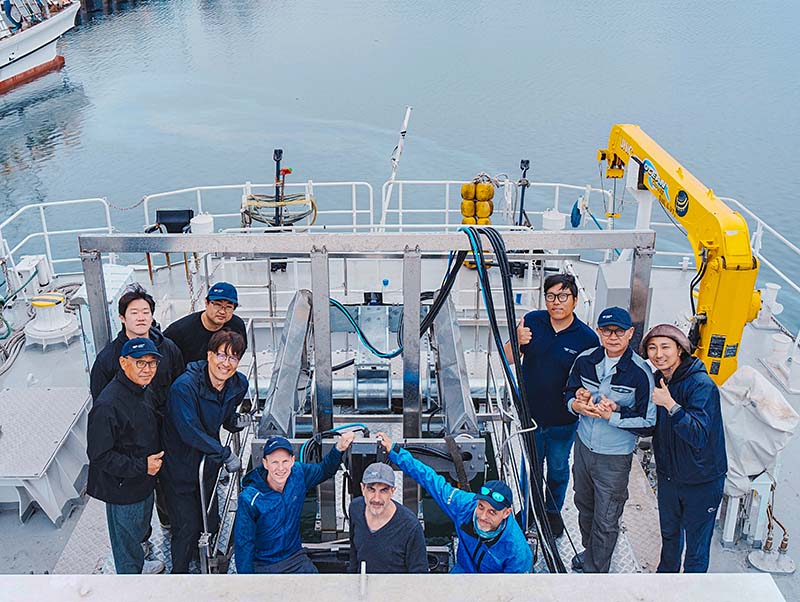
SeaBat D100 launch, Teledyne Marine conducted several sea trials, including one offshore South Korea.
Operating from a vessel of opportunity in water depths exceeding 1,000 meters, this trial demonstrated the compact deep-water multibeam echosounder’s ability to deliver high-density bathymetric data, maintain wide swath coverage, and simplify survey operations through automated controls and flexible deployment.
Sea Trial from a Vessel of Opportunity
The Korean trial was designed to demonstrate the
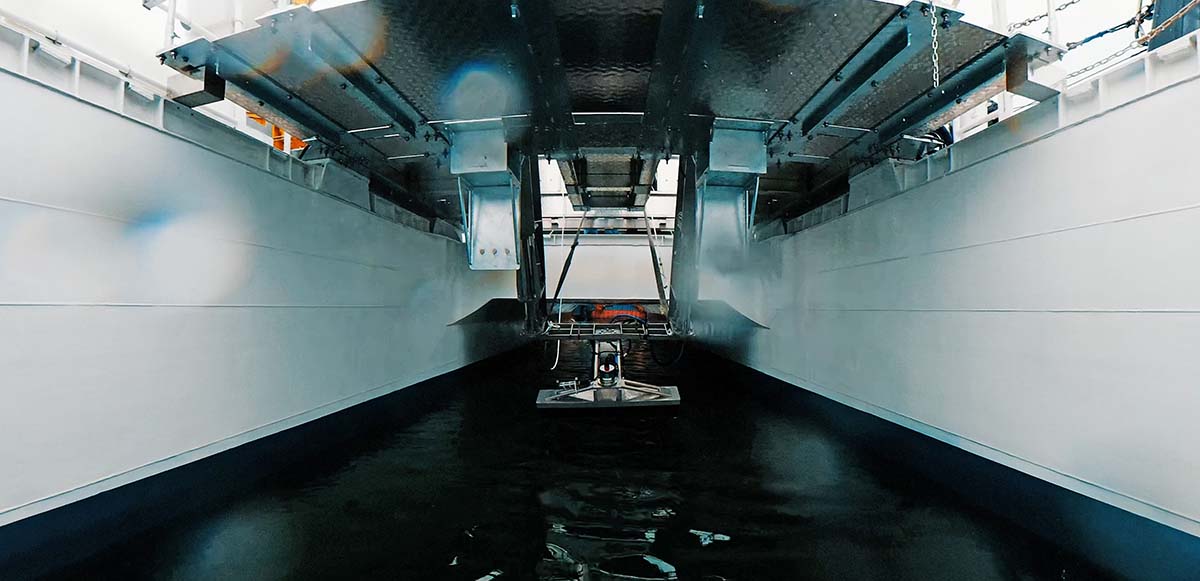
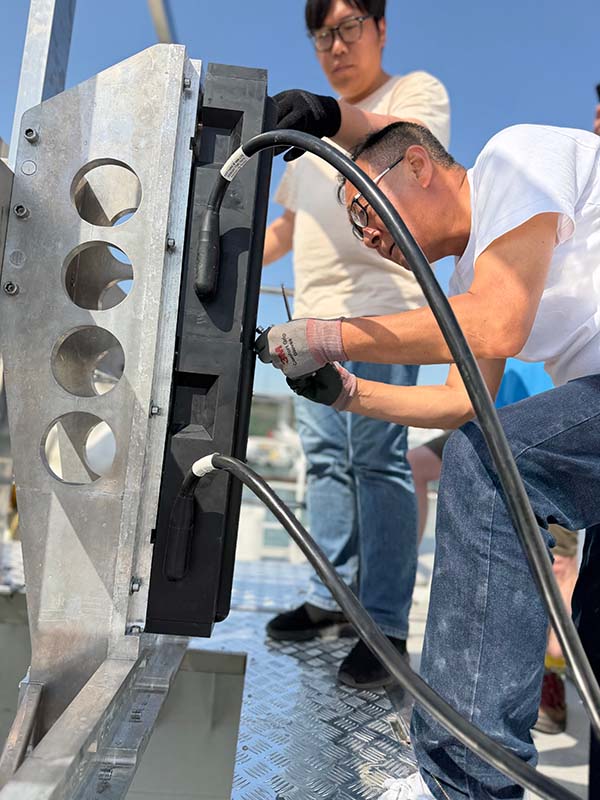
SeaBat D100’s suitability for deployment on a vessel of opportunity. Installed via a moonpool in a pole-mounted configuration, the compact sonar head and 19-inch rack-mounted electronics enabled rapid mobilization without the extensive vessel modifications often required for deep-water multibeam systems.
Developed for portable deployments and temporary survey needs, the
SeaBat D100 can be transferred efficiently between platforms, making it well suited to projects where dedicated survey vessels are unavailable.
High-Density Mapping at Depth
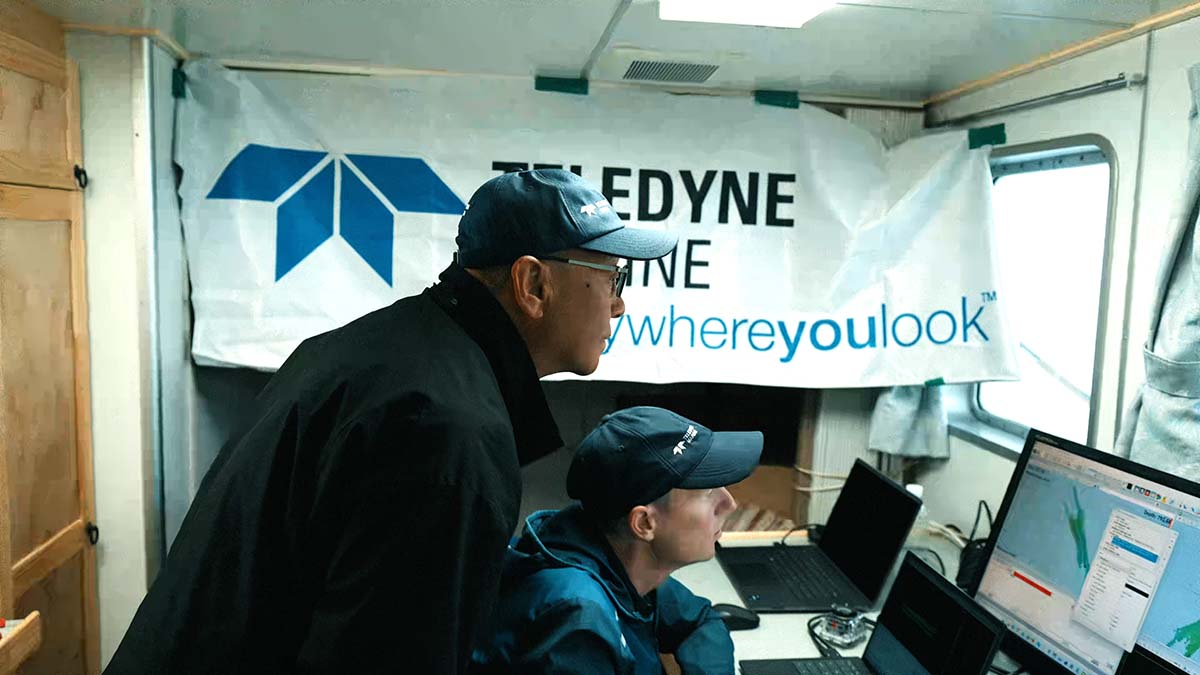
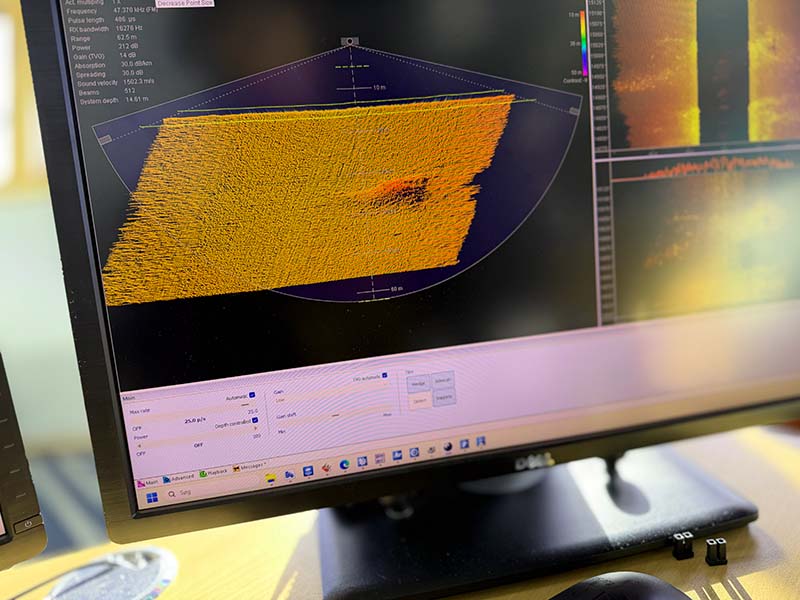 Survey operations were carried out in water depths of more than 1,000 meters, with operators monitoring georeferenced bathymetric data in real time. Throughout the trial, the system delivered consistent performance while producing detailed seabed mapping.
A key focus was the
SeaBat D100’s 4x multi-ping capability, which significantly increases along-track sounding density. By collecting more measurements during each pass, survey teams can improve data resolution while reducing overall vessel time.
Stable Performance in Challenging Conditions
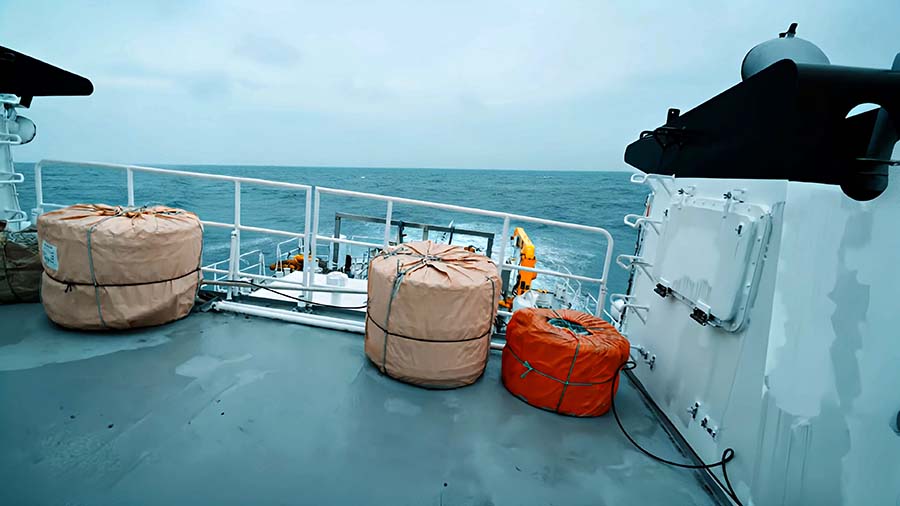
Despite Sea State 3-4 conditions with occasional larger waves, the SeaBat D100 maintained stable operation and achieved swath coverage exceeding three times the water depth. Built-in roll and pitch stabilization helped compensate for vessel motion, supporting consistent coverage and reliable data quality. Whilst yaw induced gaps are filled in by adding more detections through multi-ping.
Designed for Efficient Deep-Water Surveys
Operating between 44 and 60 kHz, the
SeaBat D100 is designed for depths from 10 to 3,000 meters. Supporting both CW and FM pulse technologies, the system captures bathymetry, backscatter, and water-column data, providing a comprehensive dataset for hydrographic and offshore applications.
During the trial, automated control of parameters such as range, pulse length, and gate settings reduced operator workload while maintaining optimized performance. Combined with familiar SeaBat workflows, these features can simplify training and help survey teams focus on data quality and mission objectives.
Demonstrating Performance in the Field
The Korea sea trial formed one part of the SeaBat D100’s broader validation program, confirming its performance under real survey conditions. By combining portable deployment, deep-water capability to 3,000 meters, high-density multi-ping technology, beam stabilization, and automated operation, the system offers survey organizations greater flexibility to conduct high-quality deep-water mapping from a wider range of vessels.
Watch a SeaBat D100 sea trail mini demo
Just offshore South Korea sea trials have been conducted to validate the SeaBat D100’s suitability for deployment on a vessel of opportunity.
Survey operations were carried out in water depths of more than 1,000 meters, with operators monitoring georeferenced bathymetric data in real time. Throughout the trial, the system delivered consistent performance while producing detailed seabed mapping.
A key focus was the SeaBat D100’s 4x multi-ping capability, which significantly increases along-track sounding density. By collecting more measurements during each pass, survey teams can improve data resolution while reducing overall vessel time.

