At the surface, the river Daugava gives little away. To the naked eye, it’s a shifting environment full of rusty waters, changing depths, and little indication of what lies below. For hydrographers at LVR Flote, however, it tells a different story.
With high-resolution sonar technology from Teledyne Marine, the unseen becomes visible: riverbed features come into focus, debris is clearly defined, and, on rare occasions, something unexpected emerges.
During a routine hydrographic survey in the summer of 2025 near the mouth of the Daugava, a shape appeared that stood apart from everything else. Unlike the usual clutter of submerged objects, this was different. It was distinct, clear, and in perfect form.
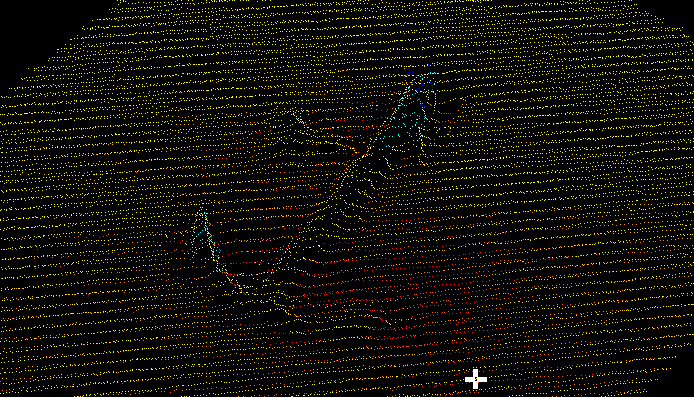
With no reports of a missing anchor in the area, it was likely to have been sitting there for a while. Measuring four meters in length and untouched for decades, it was a rare discovery and one that raised many questions.
Seeing what others can’t
LVR Flote plays a critical role in maintaining safe navigation across Latvia’s ports and waterways. With over 20 years of hydrographic experience, their team delivers essential surveying services that support port operations, dredging, and traffic control.
Their daily work typically uncovers debris such as bicycles, fallen trees, fragments of breakwater infrastructure, and even sunken vessels. So, the anchor discovery was certainly different.
“The clarity of the sonar image immediately told us this was not a typical object,” said Liga Cerusa, Chief Surveyor, LVR Flote.
“We’re used to detecting debris, but this stood out clearly in both shape and scale.”
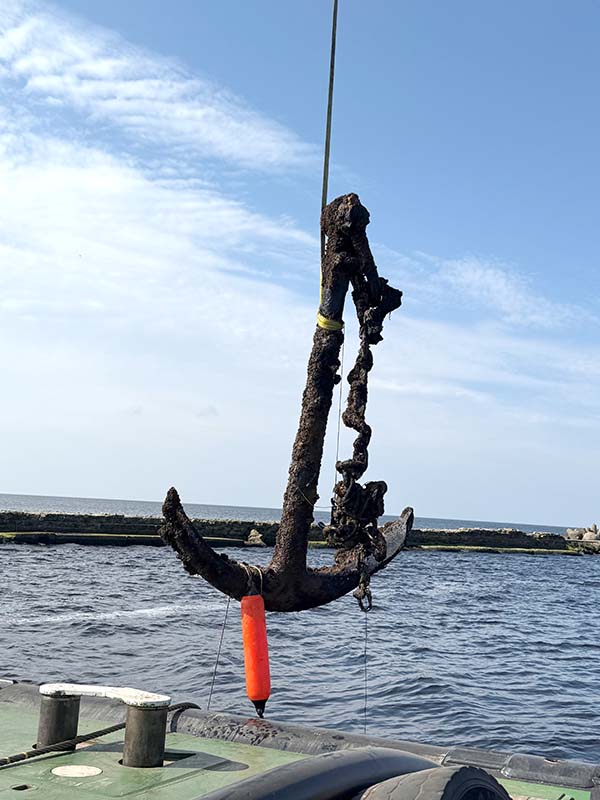
Once identified, divers were deployed to secure the anchor for recovery. The operation was carried out using LVR Flote’s multifunctional vessel LAURA, whose powerful deck equipment ensured the process was both efficient and controlled.
What began as a regular routine survey quickly turned into something far more intriguing: how did such a large anchor come to rest here, unnoticed, and for so long?
A link to the past
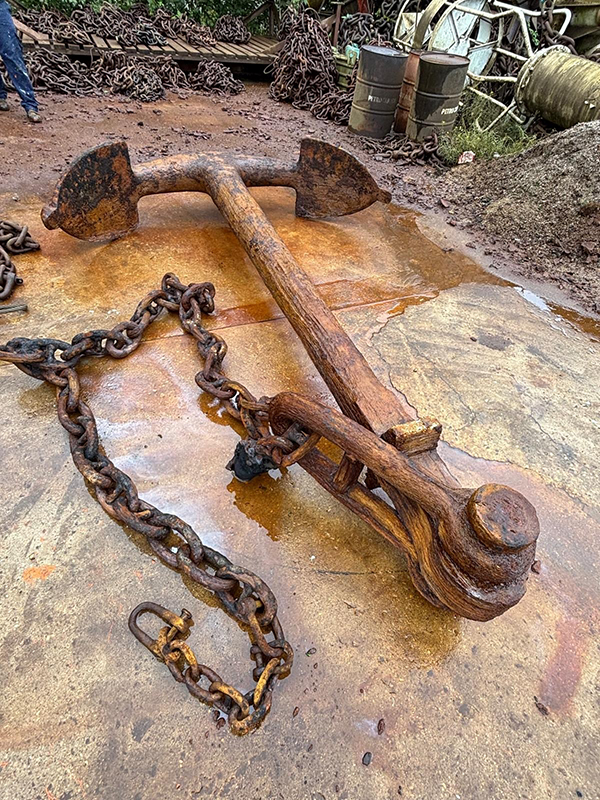 The recovered anchor, measuring approximately 4.0 × 2.5 metres and weighing around four tonnes, is consistent with 20th-century admiral-style designs used on traditional sailing vessels and tall ships.
One detail, however, deepened the mystery.
Wrapped around part of the anchor’s shank was a fragment of net bearing the name “Rīgas tīklu aušanas fabrika ‘Ķengarags’” – a Riga-based net manufacturing factory that ceased operations in the 1940s.
This small but significant clue suggests the anchor may date back to a period of significant maritime and industrial activity in the region.
But what happened? Was it lost during a storm? Detached in an accident?
For now, the answers remain unknown. But the story may soon continue on land, as LVR Flote hopes to place the anchor at its head office this summer. It will be carefully painted in a way that preserves the texture of the original material, protecting the artefact while retaining its historic character. There, it will stand not only as a striking physical reminder of the past, but also as a piece of maritime legend open to interpretation.
The technology behind the discovery
The discovery was made possible by Teledyne RESON’s
SeaBat T51-R multibeam sonar system which was integrated into LVR Flote’s survey operations in spring of 2025.
Operating at an industry-unique 800 kHz, the system delivers exceptionally high-resolution data, allowing surveyors to clearly determine the geometry of underwater objects. In this case, the anchor’s shape and orientation were captured with the highest level of detail,which was enough to distinguish it immediately from surrounding debris, even before the diving operations had commenced.
“The level of detail achieved with the SeaBat T51-R is a significant advancement in survey capability,” said Pim Kuus, Senior Hydrographer and Product Manager of Instruments & Imaging at Teledyne Marine.
“At high frequencies like 800 kHz, operators can resolve small and complex features with exceptional clarity, even in challenging turbid river environments.”
This capability is part of a broader, modern survey fleet. LVR Flote’s vessels LĪNE and LĪVA are equipped with advanced multibeam systems including the SeaBat 7125, while their USV OTTER, introduced in 2022, extends survey capabilities using the
SeaBat T20 ASV. Over the years, LVR Flote has remained a keen user of Teledyne RESON technology, standardising their fleet around systems they trust to deliver.
“For us, it’s about confidence in the data,” adds Liga Cerusa from LVR Flote.
“With Teledyne RESON systems, we know that what we see on screen accurately represents what’s on the seabed, so we don’t need to repeat our surveys. That reliability is critical for safe navigation in and out of the port, and it’s what made this anchor discovery possible.”
More than subsea mapping
Hydrographic surveying is often seen as a technical necessity, ensuring safe navigation, managing coastal resources, supporting traffic control and maritime operations. But it also serves another purpose.
It reveals what would otherwise remain hidden. Every river, port, and seabed holds unknowns. Most are routine. Some are unexpected. And a few, like the Daugava anchor, offer a glimpse into the past.
While discoveries like this are rare, the capability behind them is not. The same advanced technology from Teledyne Marine and expertise from LVR Flote are applied in every survey they undertake.
By combining decades of hydrographic experience with advanced sonar systems from
Teledyne RESON, LVR Flote continues to deliver reliable hydrographic services, while occasionally uncovering the stories history left behind.
About LVR Flote
LVR Flote is a Latvia-based port technical services provider, supporting ports with hydrographic surveying, navigation services, and fleet operations. Established in 2010, the company operates a fleet of 15 vessels with a team of over 100 specialists.

