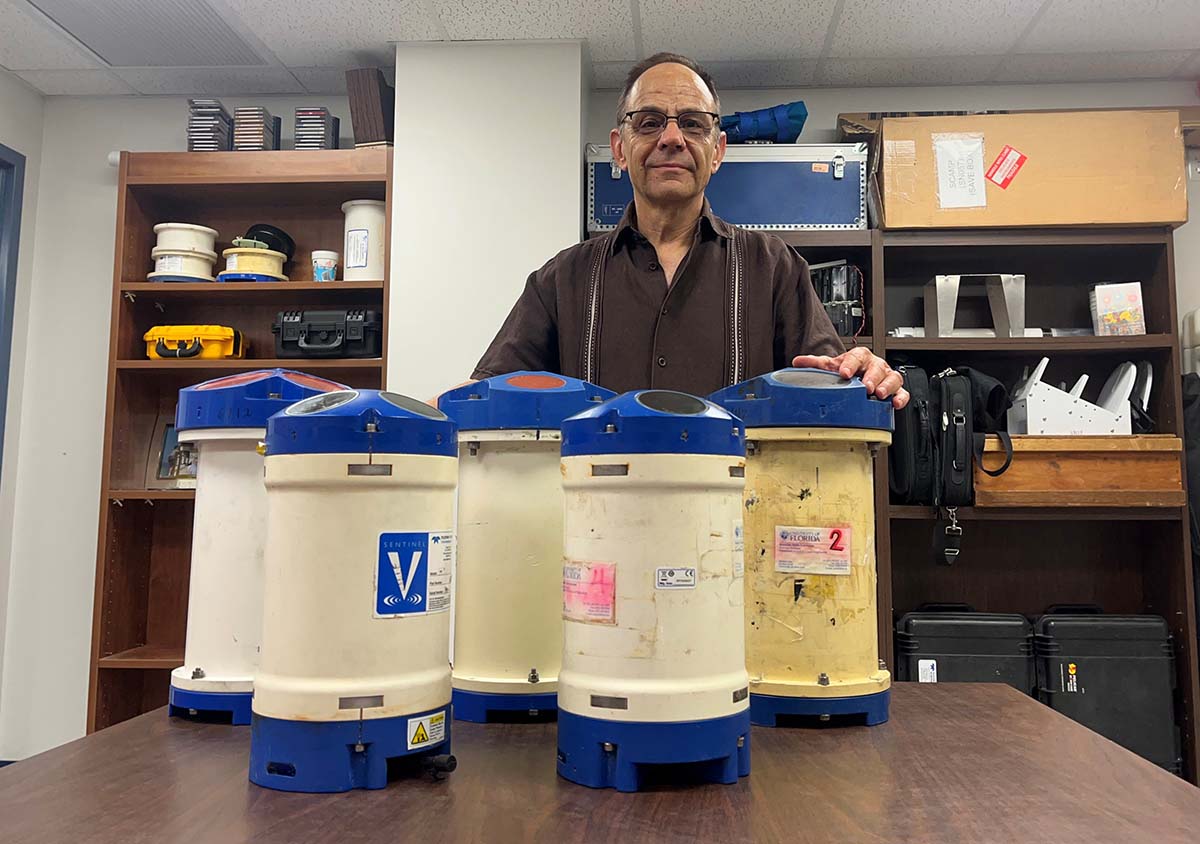
For oceanographer Arnoldo Valle-Levinson, the evolution of Teledyne's Acoustic Doppler Current Profilers didn't just make fieldwork easier. It made an entire career possible.
A Career Built on ADCP Technology
In 1993, Arnoldo Valle-Levinson faced a challenge. As a postdoctoral researcher at Old Dominion University in Virginia, he aimed to study how water moved in and out of the Chesapeake Bay's mouth, the largest estuary in the continental United States, but no one had previously collected the specific cross-sectional current data he needed. The right instrument for the job existed, a towed
Acoustic Doppler Current Profiler with bottom-track capabilities, made by
RD Instruments, now Teledyne RDI. However, it was massive, heavy enough to require two people to transport. It came with a bulky console and a thick communications cable, making field deployment a logistical challenge.
Arnoldo borrowed one anyway, convincing Kamazima Lwiza, a colleague at Stony Brook University, to bring the instrument to Virginia. The data they collected during that first season became the basis for a landmark paper, validating, through direct observation, what long-standing theory had predicted about how estuaries exchange water with the open ocean. It also persuaded his institution to buy an
ADCP of its own. That purchase launched a research program that has now lasted over thirty years, spanning nineteen countries and some of the most remote coastlines on Earth.
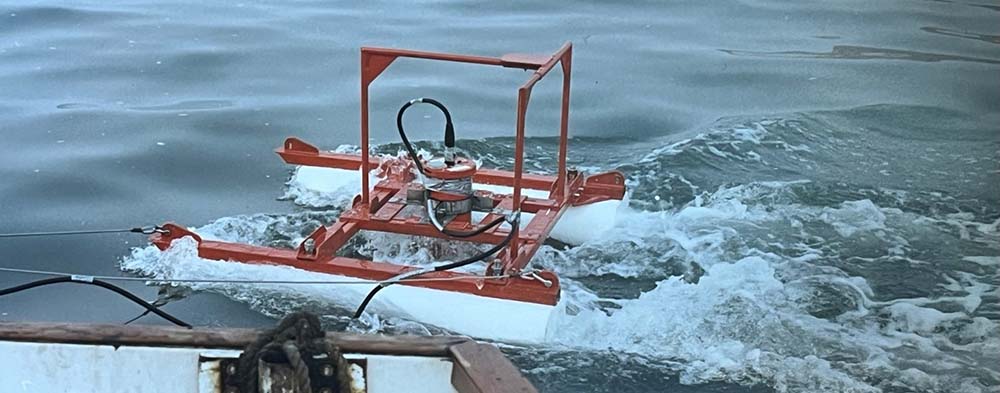
1998 – 600 kHz ADCP (early 1990s model) being towed off the coast of Sinaloa, Mexico. Photo by Arnoldo Valle-Levinson
"A towed ADCP with bottom-track capability from Teledyne shaped my career," Arnoldo says. He means it literally. Now a professor in the Department of Civil and Coastal Engineering at the University of Florida, he has used successive generations of Teledyne RDI instruments to develop a comprehensive dynamical framework explaining how estuaries, fjords, and semi-enclosed coastal basins function, work that has implications for pollution tracking, fisheries management, and climate science.
The Torpedo Era
The early broadband ADCPs that Arnoldo first used in the mid-1990s were engineering marvels but also logistical nightmares. Researchers called them "torpedoes" because of their size and weight. Deploying one in towed mode meant transporting not just the instrument but also a heavy communications cable and a dedicated console. Field campaigns required careful planning to overcome the hardware's limitations.
"It wasn't logistically simple," Arnoldo recalls,
"but we figured out how to do it efficiently after a couple of tries." He and his team built a custom catamaran to mount the
ADCP for towed operations, then launched an ambitious campaign to transport the instrument across Latin America, reaching Chile, Mexico, Argentina, and most countries in Central America. They were collecting the first towed ADCP data with bottom track ever recorded in the region. Each trip involved shipping or carrying heavy equipment through customs, negotiating temporary import permits, and improvising with whatever boats were available locally.
In Chile, they recorded currents of up to 3.5 meters per second in Chacao Channel and were caught in a sudden storm that nearly capsized their fishing boat. In Central America, a towed survey across the Gulf of Fonseca, which crosses three countries, ended with the research team detained overnight by the Nicaraguan Navy. The science was excellent. The fieldwork was an adventure.
The Game Changer
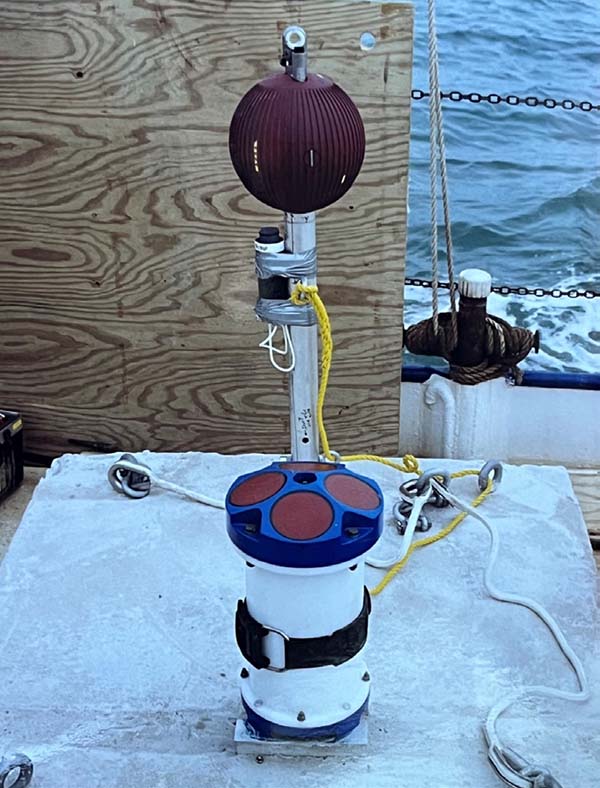 The turning point came when Teledyne RDI introduced bottom-track capability on the Workhorse ADCP. For Arnoldo, it transformed everything. The Workhorse was dramatically smaller and lighter than the older instruments. The heavy console was gone. The cable was lighter.
"That was a game changer for our operation," he says, "because we could go anywhere. Everything fit in a suitcase. Many times, I didn't have any problems with customs because they saw it was a suitcase." The reduction in size and weight didn't just simplify travel; it expanded the range of environments his team could access. With a lighter instrument and minimal support equipment, they could work from small local fishing boats in developing countries, needing nothing more than a vessel with a battery and an alternator. Sophisticated coastal science was no longer limited to well-funded institutions with dedicated research vessels.
Every new generation of Teledyne instruments added more capabilities. The Sentinel V, with its fifth beam for measuring vertical velocity, provided Arnoldo with data quality he previously could only get through costly custom orders. He especially appreciated its streamlined connectivity.
"I really liked the fact that you need one cable to do everything you need to do with the instrument," he says. When he compared Sentinel V data with that from a competitor's instrument of similar specs, the Teledyne system produced better results for towed operations.
Then came the
StreamPro, which Arnoldo affectionately calls
"a toy." Much smaller than even the Workhorse, the StreamPro created an entirely new category of fieldwork: shallow streams and channels less than four meters deep.
"That allows us to get the data we are used to getting," he says, noting that its bottom-track capability and fine bin resolution maintain the same scientific rigor as the larger instruments, just in miniature.
A Framework for the World's Estuaries
The reduced size and increased ease of use of Teledyne's evolving
ADCP line not only simplified Arnoldo's fieldwork but also enabled a new kind of science. By gathering comparable towed ADCP data from numerous estuarine systems across several continents, ranging from Chesapeake Bay to Chilean fjords and from tropical lagoons in Mexico to glacial regions in Greenland, he built the observational foundation for a unified dynamic framework explaining how these systems behave.
The framework explains how three main forces: tides, wind, and river discharge (shown as density gradients), interact to shape flow patterns in any given estuary. It highlights the important but often overlooked lateral variation in these systems: water doesn't move uniformly across a channel but could flow seaward over shoals and landward through the deep channel.
"That is the song I've been trying to sing throughout my career," Arnoldo says.
"There's a lot of variability across the channel that, if you go out and take a measurement in one location, won't give you the full picture."
The practical implications are considerable. In Mexico, his team recorded an estuary near a fish-processing plant that reverses its flow seasonally, pushing industrial waste back into the city during the dry season instead of carrying it out to sea. In Chesapeake Bay, ADCP measurements helped identify a retention gyre near the bay's mouth that may be key to blue crab larval survival. In Greenland, ongoing research is examining how warm ocean water reaches glacier fronts via fjord circulation, a feedback mechanism that accelerates ice-sheet melting.
The Instruments Behind the Science
Asked what distinguishes Teledyne RDI systems from alternatives, Arnoldo points to three factors. First is the proven reliability of bottom-track data in towed mode, the foundational capability on which his entire research program depends.
"I know that the bottom-track data with Teledyne ADCPs has provided reliable results," he says.
"I don't know if I would collect as good data with other instruments."
Second is data quality. Modern Teledyne instruments can ping at rates that allow extensive real-time averaging, producing cleaner velocity profiles than earlier systems could achieve. The ability to work in increasingly shallow water, from 200-meter depths with a 300 kHz instrument down to sub-four-meter channels with the
StreamPro, has expanded the range of environments accessible to a single research program without requiring multiple specialized platforms.
Third, and not least, is customer service.
"The quality of the product is essential, but the customer service has been exceptional," says Arnoldo.
The Next Dive
After three decades of deploying
Teledyne ADCPs in some of the most challenging coastal environments worldwide, Arnoldo shows no signs of slowing down. His team continues to study glacial fjord dynamics in Greenland, seasonal regime shifts in tropical estuaries, and the fundamental physics of water exchange between enclosed basins and the open ocean. He is closely following the development of the
Teledyne RDI Proteus.
What started with a borrowed instrument and a borrowed boat in the Chesapeake Bay has grown into one of the most geographically extensive observational programs in physical oceanography, built, generation by generation, on the increasing ease of use, accuracy, and versatility of a single line of instruments.
"It allowed me to go to different coastal environments throughout the world," Arnoldo says,
"collect the information, and ultimately synthesize it into one dynamical framework. And I think that's thanks to the vision I've gained from collecting data in different parts of the world."
The instruments have changed. The mission hasn’t. And the next generation of Teledyne ADCPs is already on the horizon.

